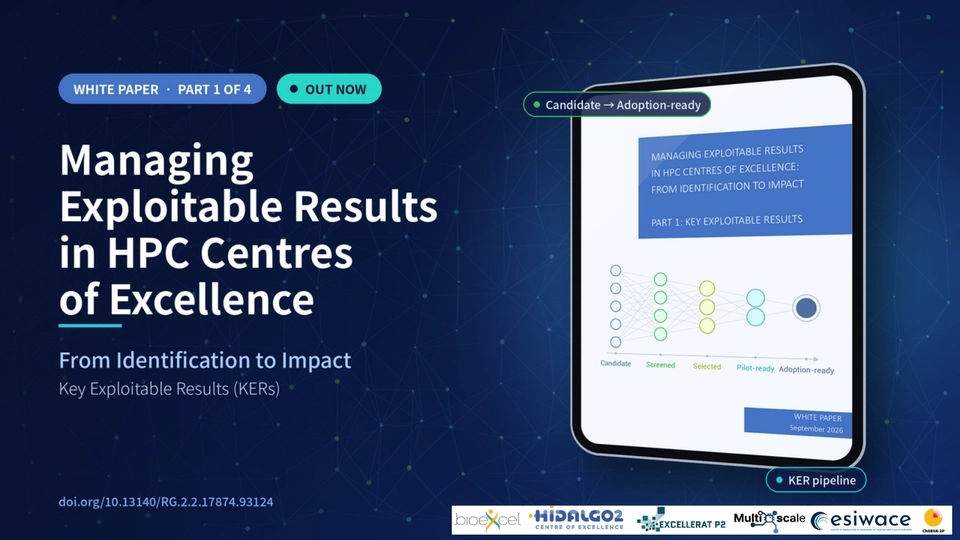
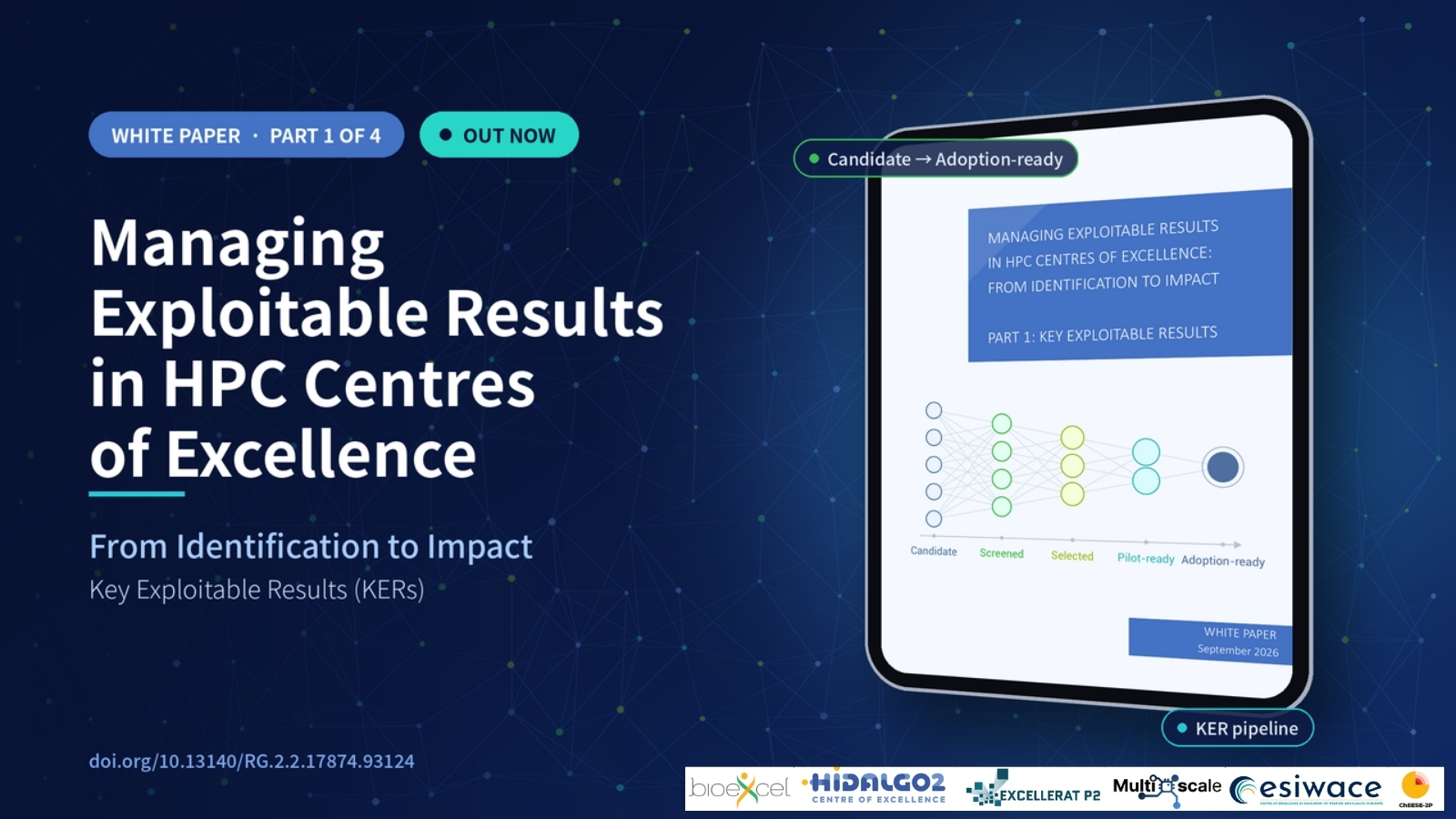
A new white paper developed by professionals from six European HPC Centres of Excellence provides practical guidance on identifying and selecting Key Exploitable Results (KERs) to maximise the impact of research outcomes.
How can we ensure that valuable research results continue to deliver impact beyond the lifetime of a project? This is a shared challenge for European High Performance Computing (HPC) Centres of Excellence (CoEs), which develop scientific software, tools, services and other results with the potential to benefit the wider research community and beyond.
To address this challenge, ESiWACE3 has contributed to a new collaborative white paper, Managing Exploitable Results in HPC Centres of Excellence: from Identification to Impact – Part 1: Key Exploitable Results. The publication brings together professionals from six European HPC CoEs to establish a practical framework for identifying, assessing and selecting research results with exploitation potential.
Alba Abia, from the Barcelona Supercomputing Center (BSC) and ESiWACE3, is one of the six co-authors, contributing to this cross-project effort through the Sustainability Vision for CoEs Taskforce, established within CASTIEL-2.
From research results to real-world impact
The 16-page white paper addresses the innovation “valley of death”, where promising research results struggle to progress towards adoption. It highlights the importance of identifying potential Key Exploitable Results (KERs) early and assessing their potential systematically, rather than assuming that every technically successful outcome should become a KER.
The paper introduces a practical framework that includes:
- A minimum evidence checklist to assess potential KERs, covering target users, value proposition, alternative solutions and ownership.
- A five-stage pipeline, from initial candidate identification to adoption readiness, with documented decision gates to support evidence-based decisions.
- A classification of exploitable results commonly developed by HPC CoEs, including software, workflows, data assets, services and training products.
- A multidimensional readiness model covering technology, market, investment and societal considerations.
These elements provide a structured starting point for research projects seeking to move beyond producing results and towards ensuring that those results can be used, maintained and developed further.
A joint effort across six European CoEs
The white paper is the first in a four-part series exploring how to manage research results to maximise their impact. It follows the taskforce’s 2025 publication on building commercialisation capabilities in Centres of Excellence.
The six co-authors represent expertise in research, exploitation, innovation and communication across the following projects and organisations:
- Richard A. Norman (Norman Consulting, BioExcel)
- Marcin Lawenda (Poznan Supercomputing and Networking Center, HiDALGO2)
- Anne-Bernard Bedouet (SICOS BW, EXCELLERAT P2)
- Giulia Zunino (HPCNow!, MultiXscale)
- Alba Abia (Barcelona Supercomputing Center, ESiWACE3)
- Aerton Guimarães (Barcelona Supercomputing Center, ChEESE-2P)
The series is aimed at researchers and developers, project coordinators, and innovation and exploitation managers working in HPC Centres of Excellence and European research and innovation projects with exploitable digital results.
The next publications will address exploitation strategies (Part 2), readiness assessment and maturation (Part 3), and adoption, scale-up and sustainability, supported by real examples from the CoEs (Part 4).
Read the white paper
Managing Exploitable Results in HPC Centres of Excellence: from Identification to Impact – Part 1: Key Exploitable Results